
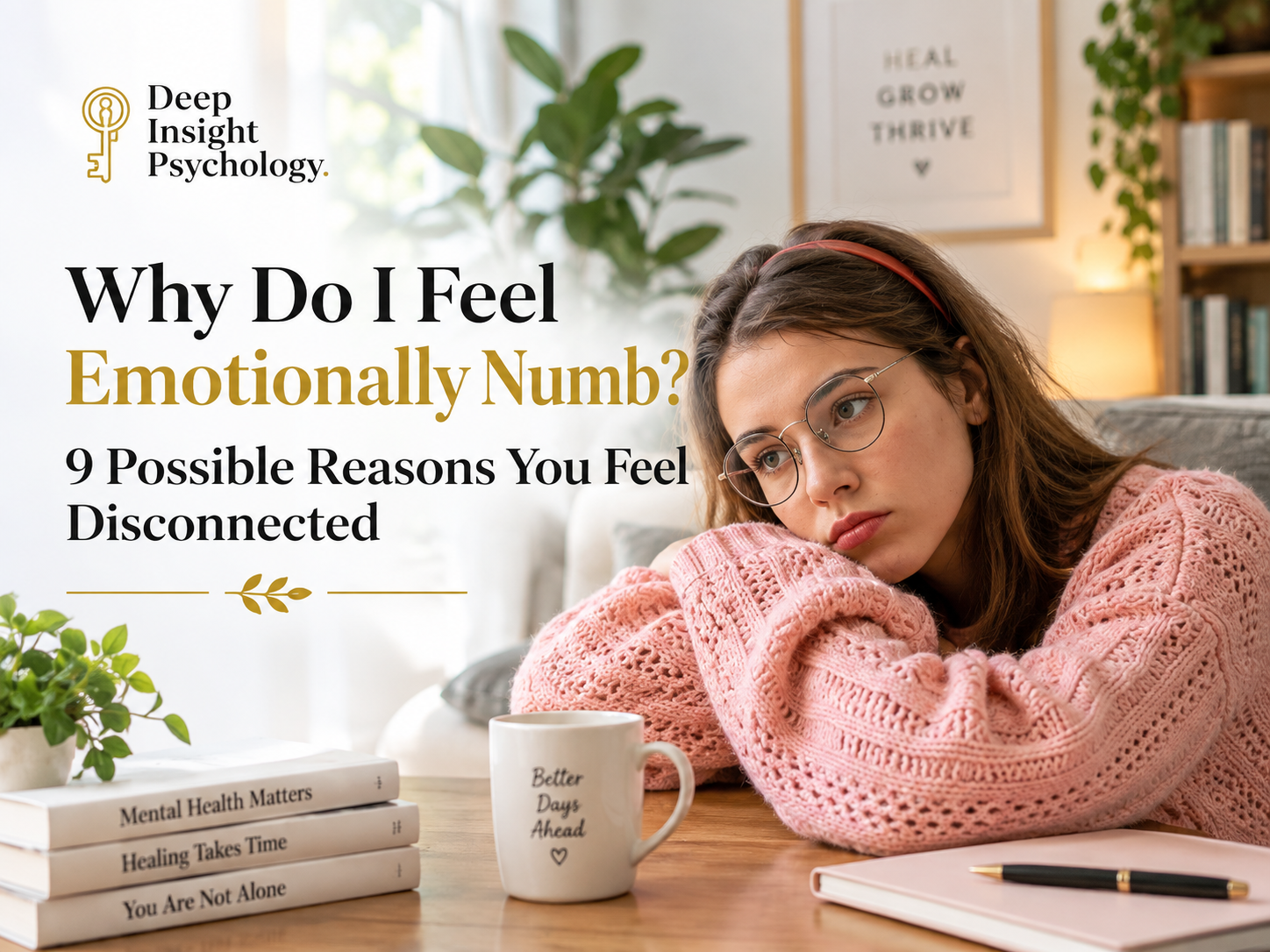
Ever noticed how you can go about your day-to-day life but without really feeling anything? You are laughing at the right time and responding appropriately to everything, yet, internally you are experiencing a weird void, like someone turned off the volume of your own feelings. Have you ever asked “why do I feel emotionally numb?” You are not wrong and you are not alone in that either; it is one of the most common issues that people come to therapy with.
In this guide, we will talk about what is emotional numbness, nine possible causes behind it, and when it’s time to contact an emotional support therapist.
What Does Feeling Emotionally Numb Actually Mean?
Not feeling anything emotionally does not mean that one is relaxed or “fine”; rather, it means that there are no emotions being felt normally. Scientists refer to it as a milder form of dissociation, the technique by which the mind keeps an individual protected from emotions that might be difficult to cope with right away.
On a short-term basis, numbness may be helpful because it is the brain’s response to a crisis; however, things turn problematic when numbness becomes one’s normal state of being.
9 Reasons You Might Feel Emotionally Numb
1. Chronic, Untreated Stress
When levels of stress hormones remain high for weeks or months on end, the nervous system may go from “fight or flight” to the freeze position, causing flattened emotions as it conserves energy in anticipation of ongoing stress.
2. Depression
Emotional numbness is commonly misread as sadness, but in many cases of depression, patients report a lack of emotion rather than crying, which is called “emotional blunting.”
3. Overwhelming Anxiety
Chronic anxiety leaves the nervous system constantly vigilant, and eventually this takes its toll on the nervous system until it becomes increasingly difficult to feel emotional reactions.
4. Unresolved Trauma
Traumatic or stressful events may cause individuals to dissociate as a coping mechanism. In one study that followed almost 3,500 children who had experienced violence, it was found that the longer their exposure to violence, the more emotionally desensitized they became.
5. Side Effects of Anti-depressants or Medicine
There are well-documented instances of emotional flatness as a side effect of several psychiatric drugs. An oft-cited study involving over 1,800 adult patients on anti-depressants revealed that about 6 out of 10 patients experience some form of emotional numbness, one of the common but less spoken-of reasons for discontinuing treatment.
6. Burnout
Excessive work pressure or caregiving stress without proper time to recover from it often leads to the state of burnout, manifested as emotional detachment, cynicism, and being on autopilot.
7. Unresolved Grief
There are cases when emotional numbness is actually an expression of unresolved grief. When the grief is so overwhelming that one cannot deal with it properly, the brain “freezes” the grieving process.
8. Mental Disorders
In certain cases, emotional numbness could be related to such psychological disorders as depersonalization-derealization disorder, borderline personality disorder, or bipolar disorder.
9. Physical Illness or Chronic Pain
Ongoing physical issues affect the nervous system negatively. Illnesses and chronic pain always go hand in hand with emotional exhaustion and lack of emotional sensation.
Quick Reference: Common Causes at a Glance
| Possible Cause | How It Typically Feels | Often Paired With |
| Chronic stress | Flat, “running on empty” | Fatigue, irritability |
| Depression | Hollow, disconnected | Low motivation, sleep changes |
| Anxiety | Detached, on edge | Racing thoughts, restlessness |
| Trauma | Disconnected from body or memory | Flashbacks, avoidance |
| Medication side effects | Blunted highs and lows | Reduced pleasure, low libido |
| Burnout | Checked out, cynical | Exhaustion, dread of routine |
| Unprocessed grief | Frozen, distant | Guilt, difficulty crying |
| Dissociative/mood disorders | Detached from self or reality | Mood swings, derealization |
| Chronic illness or pain | Drained, muted | Sleep issues, low energy |
When Feeling Numb Emotionally Becomes a Concern
It’s natural to feeling numb from time to time following a stressful week. But if this becomes a recurring thing or you experience numbness that lasts for several weeks, or this affects your relationships and work, or even accompanies feelings of hopelessness, then seeking help from an emotional support therapist would be beneficial.
If you’re searching for an emotional support therapist near me and want a compassionate place to start, Deep Insight Psychology offers personalized, insight-oriented therapy for adults navigating anxiety, depression, trauma, and emotional disconnection, both in person and online.
How Therapy Can Help You Begin To Feel Again
Unlike a counselor who simply discusses your numbness with you, a properly trained therapist can guide you through uncovering its origin, be that stress, trauma, medication, or an underlying mood disorder. In many cases, therapy using psychodynamic and cognitive behavioral techniques successfully helps individuals begin feeling happiness, affection, and even sorrow once again without being overpowered by these feelings, all within a non-judgmental setting that respects your boundaries and pace.
Conclusion
The sensation of disconnecting yourself from your emotions is unnerving, but it’s an important message that needs to be heeded, rather than suppressed. Regardless of what is causing your numbing sensation, stress, grief, trauma, or something different, help is out there. The dedicated professionals at Deep Insight Psychology are ready to assist you in re-establishing your emotional awareness, at your own pace.
Frequently Asked Questions
1. How is it possible to feel emotionally numb for no reason?
Numbness almost never happens “for no reason” ; there must always be some sort of stress, unresolved emotions, or an illness that has been accumulating over time, even if the reason may not be readily apparent.
2. Is numbness the same thing as depression?
Not necessarily. Numbness may result from depression, but may also come about from anxiety, trauma, medication, and other factors without a diagnosis of depression.
3. Does the numbness ever go away by itself?
Short term numbness that occurs after a stressful experience may resolve itself. Otherwise, numbness will likely need professional treatment to address the underlying issues.
4. What is the difference between feeling numb and calm?
While a state of calm leaves one feeling stable and present, a state of numbness leaves one feeling distant and empty, as though emotions have been numbed or blocked off.
5. Should I visit an emotional support therapist if I feel numb?
A few weeks of emotional numbness, especially if it is disrupting your interpersonal relationships and day-to-day life, accompanied by feelings of hopelessness, is a good case for visiting a therapist.